Guide
CNC TCO Guide
Connect purchase price to energy, maintenance, software, tooling, floor space, and support overhead across the full lifecycle.
Reviewed: 2026-03-08Source: Reviewed against ISO 230, GB/T 17421, OEM documentation, and shop-floor calculator assumptions.
Direct answer: TCO = acquisition + energy + maintenance + tooling + software + overhead across the full lifecycle, not just the invoice price.
Run the Numbers
Don't rely on rough estimates. Our TCO Calculator helps model depreciation, energy, maintenance, and overhead assumptions across your planning horizon.
The 5 Pillars of TCO
Total Cost of Ownership (TCO) aggregates all direct and indirect costs associated with an asset over its entire lifecycle. For CNC budgeting, many teams model a multi-year horizon and then run sensitivity checks for demand, energy, and reliability assumptions.
1. Acquisition (CapEx)
- Machine Price
- Shipping & Rigging
- Training
- Initial Tooling Package
2. Operating Energy
- Spindle Power
- Compressed Air (Huge cost!)
- Coolant Pumps
- Idle Power Draw
3. Maintenance
- Preventative (Oil/Filters)
- Unplanned Repairs
- Spindle Rebuilds (based on duty cycle)
- Ball Screw Replacement
4. Software & Licensing
- CAM Subscriptions
- Machine Options (HSM, Lookahead)
- ERP/MES Integration
- Post-Processor Updates
5. Floor Space & Overhead
- Rent / Lease (per sq ft)
- HVAC Heat Load
- Insurance
- End-of-Life / Disposal
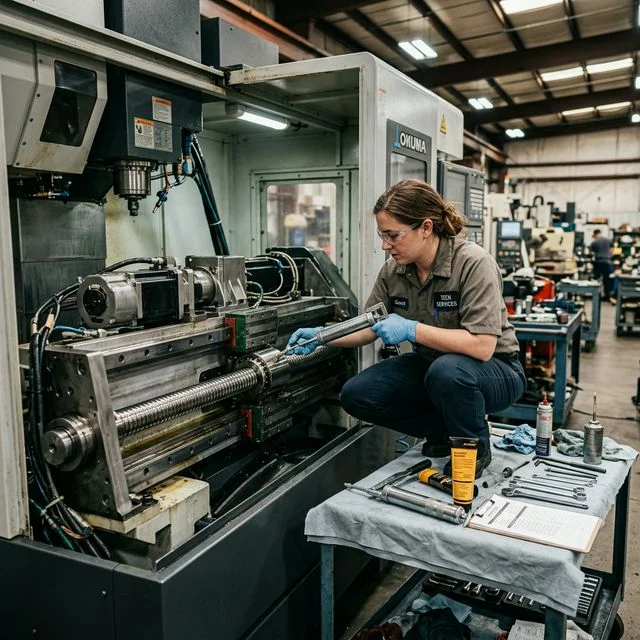
The "Hidden" Costs
Software & Licensing
CAM subscriptions, machine options (High Speed Machining, 1000 Block Lookahead), and ERP integration often add ongoing annual costs that should be modeled explicitly by machine, product mix, and software stack.
Floor Space & Utilities
Total footprint includes machine envelope, maintenance clearance, chip/coolant handling, and material flow aisles. Include HVAC and utility load in facility overhead allocation.
Consumable Tooling
Often the largest variable cost. Inserts, end mills, drills, and taps. Model tool consumption from actual part mix, material class, and historical tool-life data.
Critical Planning Inputs
Maintenance Model
Task-Based
Use PM task history plus contingency reserve
Depreciation Method
7 Years
U.S. tax treatment can use 7-year MACRS; verify with your tax advisor and jurisdiction
See a Real-World Example
We applied this framework to a CMM (Coordinate Measuring Machine) purchase for an aerospace shop.
Read the CMM TCO Case Study →Related Guides
Frequently Asked Questions
What is CNC machine Total Cost of Ownership (TCO)?
TCO aggregates direct and indirect costs across the planning horizon, including acquisition, energy, maintenance, tooling, software, floor space, and support overhead.
What are the 5 pillars of CNC machine TCO?
(1) Acquisition (CapEx): machine price, shipping, training. (2) Operating Energy: spindle, compressed air, coolant pumps. (3) Maintenance: PM, repairs, spindle rebuilds. (4) Software & Licensing. (5) Floor Space & Utilities.
How much should I budget for CNC machine maintenance annually?
Use a task-based budget from your maintenance history, then add contingency for major repairs and parts lead-time risk. Fixed percentage rules can be used only as a rough screening check.
What hidden costs are commonly overlooked in CNC purchasing?
Common misses include software lifecycle cost, compressed-air burden, full floor-space allocation, consumable tooling variance, and HVAC/utility impact.
What is the standard depreciation period for CNC machines?
For U.S. tax planning, machinery is commonly modeled under 7-year MACRS class treatment. Confirm tax treatment and useful-life assumptions with your accountant for your specific jurisdiction.