The 3 Pillars of Hard Milling
Machining steel above 50 HRC requires a fundamental shift in strategy. You cannot "plow" through material. You must slice it.
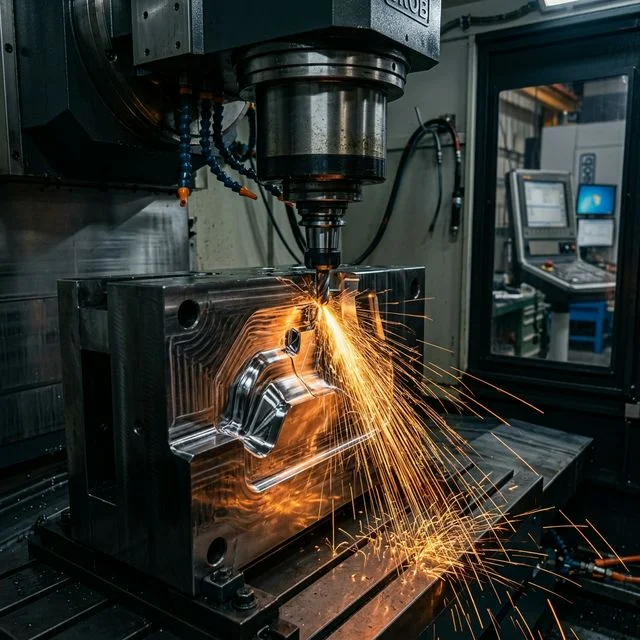
1. Light Radial Engagement (Ae)
Use Trochoidal / Dynamic Milling paths. Keep Radial Depth of Cut (Ae) between 3% and 7% of cutter diameter. This reduces heat buildup and allows for higher speeds.
2. NO COOLANT (Usually)
Thermal shock kills carbide. In hard milling, the cutting edge heats up to 1000°C instantly. Hitting it with cold coolant causes micro-cracking. Use Air Blast only.
3. Negative Rake Geometry
Sharp tools chip instantly. Hard milling tools have a negative rake (strong edge) preparation. Do not use aluminum-cutting end mills on hardened steel.
Speeds & Feeds Rules of Thumb
| Hardness | Speed (SFM) | Chip Load (ipt) | Coating |
|---|---|---|---|
| 40-48 HRC | 300 - 450 SFM | 0.001 - 0.003" | AlTiN |
| 48-58 HRC | 200 - 350 SFM | 0.0005 - 0.002" | AlTiN / TiSiN |
| 58-65 HRC | 150 - 250 SFM | 0.0002 - 0.001" | AlTiN / TiSiN |
Related Calculators
Use these calculators to convert hard-milling strategy into spindle speed, feed, and cutter-loading numbers before you cut hardened steel.
High Speed Machining Calculator
Model constant-engagement cuts, chip thinning, and adaptive toolpaths for hardened-steel workflows.
Chip Load Calculator
Back-solve conservative feed per tooth for hard-milling edge strength and heat control.
RPM & Cutting Speed Calculator
Convert SFM and diameter into spindle speed before you finalize the hard-milling process window.