The "Sticker Shock" Problem
In many sourcing events, a 5-axis package is quoted above a similarly sized 3-axis package. The headline delta is real, but purchase price alone is incomplete because it excludes WIP exposure, scrap risk, and setup labor intensity.
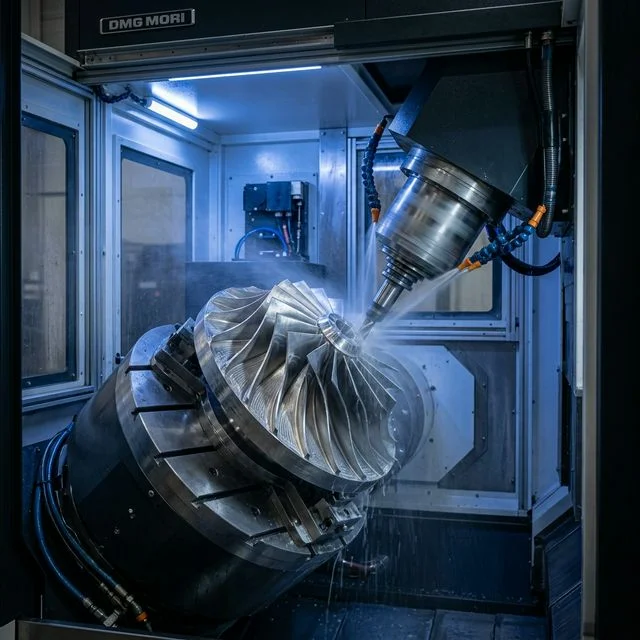
3+2 Positional vs Simultaneous 5-Axis
| Feature | 3+2 Positional (Indexed) | Simultaneous Full 5-Axis |
|---|---|---|
| Axis Movement | Rotates to angle, locks brakes, then machines in 3 axes (X,Y,Z). | All 5 axes (X,Y,Z,A,B/C) move continuously and simultaneously through the cut. |
| Ideal Use Case | Multi-sided prismatic parts (blocks, valve bodies, manifolds). Reaching 5 sides of a cube. | Aerospace impellers, turbine blades, complex organic molds, 3D contouring. |
| Tool Length | May require longer tools to reach into deep locked pockets. | Allows extremely short tools by continually tilting the spindle away from walls. |
| Software Cost | Lower. Most Mid-tier CAM packages support 3+2 indexing naturally. | High. Requires advanced CAM modules and robust kinematic machine simulation. |
The True Cost of 5-Axis Adoption
If you are moving from 3-axis to 5-axis, budget for the surrounding ecosystem. Machine price is only one line in the business case.
- CAM Software Scope: Simultaneous toolpath modules, collision control, and training time for programmers.
- Post-Processor Readiness: Verified machine-specific post behavior, TCPC handling, and simulation validation.
- Workholding System: Fixtures and reference strategy that allow tool access without compromising rigidity.
- Verification Workflow: Digital simulation and prove-out discipline to control crash risk and protect expensive machine components.
Treat these as mandatory enablement costs in your ROI model, not optional extras.
Case Study: The Aerospace Bracket
Consider a modeled aerospace bracket workflow to illustrate how setup reduction can influence cash flow.
Legacy 3-Axis Process
- Op1: Face top, rough outline (Vise 1)
- Op2: Flip, face bottom, drill base (Vise 2)
- Op3: Stand on end, drill side A (Vise 3)
- Op4: Flip to side B, mill pocket (Vise 4)
- Op5: Custom soft-jaws to machine angle.
Illustrative Result: 5 setups with multi-queue handoffs
5-Axis "Done-in-One"
- Op1: Clamp on dovetail raw stock. Machine top, bottom, all 4 sides, and angles simultaneously.
- Op2: Flip into simple soft jaws, deck off the dovetail base.
Illustrative Result: 2 setups with compressed queue exposure
The ROI Math
Formula Chain
Formula chain: 5-axis ROI = setup-time savings + WIP compression + scrap-risk reduction + sellable capacity - CAM, post, workholding, training, financing, and maintenance burden.
Worked Example
Worked example: reducing five setups to two saves 4.5 hours per run; at $100/hour and 20 runs per month, that is $9,000/month before CAM, fixture, prove-out, and financing costs.
Release Boundary
Release boundary: do not buy 5-axis until post-processor simulation, tool-vector clearance, operator training, workholding, TCO, and ROI capacity checks agree.
Use your own rates and lot sizes. The sample below is a modeling template, not a universal benchmark.
- 3-Axis Total Setup Time (5 Ops)5.5 Hours
- 5-Axis Total Setup Time (2 Ops)1.0 Hours
- Saved Time Per Run4.5 Hours ($450)
In this scenario, the saved setup hours become recoverable capacity. Convert that capacity into financial value only after validating sell-through, margin quality, and scheduling feasibility.
Accuracy is Free: The Cost of Scrap
Every time a part is unclamped and re-datumed, you introduce stack-up error risk. Even disciplined processes accumulate variation across multiple setup transfers.
For drawings with tight positional requirements between features cut in different operations, multi-setup workflows increase indicate-in time and quality-control burden.
A stable single- or dual-clamp process can reduce re-datum risk and simplify verification flow. In ROI terms, quality stability may be as important as cycle-time reduction.
When NOT to Buy 5-Axis (The Verdict)
Despite the incredible ROI potential, 5-Axis is a poor investment if:
- You manufacture thousands of highly simple 2D parts (brackets, plates) where a fast 3-axis pallet-changing VMC would vastly outproduce a 5-axis.
- You do primarily turned cylindrical parts (a multi-axis mill-turn lathe is better suited).
- You cannot find or afford to train programmers. A 5-axis machine without a competent CAM programmer is a $300,000 paperweight.
Frequently Asked Questions
How much more does a 5-axis machine cost than a 3-axis?
Price delta depends on travel, spindle specification, control package, probing, and included software options. Compare complete delivered packages rather than base machine price alone.
What is the difference between 3+2 positional and full 5-axis?
In 3+2 machining, the 4th and 5th axes rotate the part to a fixed angle and lock into place, then standard 3-axis milling occurs. In full simultaneous 5-axis machining, all five axes move continuously at the same time, maintaining constant tool contact with complex contoured surfaces like turbine blades or impellers.
How does 5-axis machining reduce costs?
The primary value is setup consolidation and reduced queue/re-datum exposure. Savings usually appear in setup labor, fixture complexity, WIP handling, and quality risk reduction.
What are the hidden costs of upgrading to 5-axis?
Commonly overlooked lines include CAM scope expansion, post/simulation validation, workholding redesign, prove-out time, and multi-axis programming training.
When does purchasing a 5-axis machine NOT make sense?
A 5-axis machine is a poor investment if your shop primarily runs simple 2D plates, parts that require only one or two setups, or extremely high-volume simple parts where a twin-spindle lathe with live tooling would be more appropriate. High-mix, complex geometry shops benefit most.