Back to Resources
Guide

CMM Total Cost of Ownership: 5-Year Analysis

Why the purchase price of a coordinate measuring machine is only half the story — and how to budget for the full lifecycle cost in an aerospace machine shop

Executive Summary

A coordinate measuring machine (CMM) is one of the most significant capital investments a precision machine shop can make. Purchase price is only one component of the decision. A full five-year model should include calibration, service support, software lifecycle cost, environmental controls, and operator competency development.

This guide provides a complete framework for calculating 5-year CMM TCO, including all hidden costs that procurement teams routinely underestimate. Use this framework as a scenario model and replace assumptions with your own quotes, workload data, and compliance requirements.

Modeling Principle:

Build best/base/worst scenarios using the same line-item structure so purchasing, quality, and finance can review assumptions consistently.
Measurement workflowInspection data validates the process modelSetupMeasurementAcceptanceConfirm the measurement method, cutoff, calibration state, and drawing requirement.
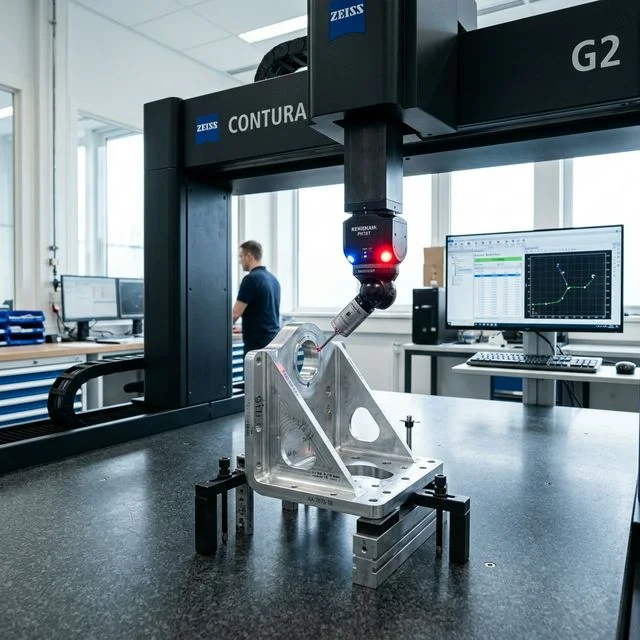
A bridge CMM inspecting an aerospace bracket; lifecycle cost planning should include calibration, software, environment, fixturing, and training

What is a Bridge CMM?

A bridge-type CMM is the industry standard for high-precision dimensional inspection in aerospace, medical device, and automotive manufacturing. The bridge design provides superior rigidity and accuracy compared to cantilever or horizontal-arm configurations.

Small Bridge CMM

Typical use: smaller envelope precision parts

Cost profile: lower initial investment, narrower capacity

Vendor-quoted range varies by configuration

Mid-Range Bridge CMM

Typical use: mixed aerospace and precision production workflows

Cost profile: balanced capacity with moderate integration burden

Vendor-quoted range varies by probe/software stack

Large Bridge CMM

Typical use: larger part envelopes and complex fixtures

Cost profile: higher infrastructure and lifecycle commitments

Vendor-quoted range varies by envelope and options

Note: Configuration changes (probe strategy, software, reporting stack) can materially change both initial and recurring cost.

5-Year TCO Breakdown: Illustrative Mid-Range Model

The following table is an illustrative scenario model. Replace every line item with your own quote and operating assumptions before making a purchasing decision.

Cost CategoryYear 1Year 2Year 3Year 4Year 55-Year Total
Machine Purchase$150,000$150,000
Installation & Foundation$12,000$12,000
Annual Calibration$4,500$4,500$4,500$4,500$4,500$22,500
Service Contract$0*$10,500$10,500$11,000$11,000$43,000
Software License$8,000$5,500$5,500$5,500$5,500$30,000
Environmental Controls$8,000$2,500$2,500$2,500$2,500$18,000
Operator Training$6,000$2,000$2,000$2,000$2,000$14,000
Probes & Consumables$3,000$2,000$4,500$2,000$4,500$16,000
TOTAL TCO$191,500$27,000$29,500$27,500$30,000$305,500

*Warranty and service timing vary by OEM contract. Confirm term boundaries in writing.

Purchase Price vs. True 5-Year TCO

Cost Distribution

Machine Purchase$150,000 (49%)
Service & Calibration$65,500 (21%)
Software Licensing$30,000 (10%)
Infrastructure & Environment$30,000 (10%)
Training & Consumables$30,000 (10%)
Total 5-Year TCO
$305,500
vs. $150,000 purchase price
2.04×
TCO multiplier

Aerospace Machine Shop Scenario

Shop Profile

  • Type: Aerospace-oriented precision job shop (scenario)
  • Primary work: Structural components with strict documentation needs
  • Inspection demand: Recurring medium-to-high volume
  • Current method: Outsourced metrology services

Cost Comparison

Annual outsourcing modelScenario input
5-year outsourcing modelScenario output
5-year in-house CMM modelScenario output
Net DifferenceCompare best/base/worst cases

Additional In-House Benefits

⏱ Faster Turnaround

Potentially shorter inspection lead time and better production synchronization.

Process Feedback Loop

Faster process feedback can improve corrective-action response time.

AS9100 Compliance

Full control over measurement traceability, calibration records, and FAIR documentation.

Hidden Costs Most Shops Underestimate

Environmental Controls

Measurement stability usually requires tighter environmental control than general shop-floor conditions.

  • • HVAC upgrade and room conditioning scope
  • • Ongoing utility burden
  • • Humidity management and monitoring

Foundation & Vibration

Bridge CMMs need vibration-isolated foundations. Proximity to CNC machines is a common problem.

  • • Isolation pad/foundation and structural prep
  • • Room partition and equipment separation
  • • Ongoing vibration verification

💻 Software Ecosystem

Metrology software licensing has shifted to subscription models, creating recurring costs.

  • • Base software and module licensing scope
  • • Annual maintenance and update contracts
  • • SPC/reporting add-ons
  • • CAD import and interoperability modules

Operator Competency

CMM operation requires specialized programming and interpretation skills; productivity ramps over time.

  • • Initial OEM/system training
  • • Advanced programming competency development
  • • Ongoing refresher and standards updates
  • • Ramp-up productivity impact

Most Overlooked Cost:

Fixture systems are frequently under-budgeted. Without robust fixturing strategy, inspection cycle time and repeatability can degrade significantly.

Five-Axis Scanning CMM: Annual Cost Breakdown

Five-axis scanning CMMs (e.g., Zeiss PRISMO with VAST XTR Gold) are the premium tier for titanium aerospace inspection. They command significantly higher maintenance and calibration costs.

Annual Cost ItemTouch Probe CMM5-Axis Scanning CMMNotes
Service ContractLowerHigherMore complex probe head requires specialized service
Annual CalibrationLowerHigher5-axis probe head adds calibration complexity
Software LicenseLowerHigherScanning analysis modules cost more
Probe ReplacementLowerHigherScanning styli wear faster on titanium
Annual Operating TotalBaselinePremiumQuantify delta using your quoted service and calibration packages

Decision Framework: Buy vs. Outsource

Not every shop needs an in-house CMM. Classify your workload and compliance constraints before choosing.

Low
Inspection Demand

Outsourcing is often simpler when turnaround pressure is moderate and compliance allows external testing.

Medium
Inspection Demand

Run best/base/worst scenarios to compare outsourcing contracts versus in-house capability.

High
Inspection Demand

In-house capability is often favored when lead-time control and traceability requirements are strict.

Non-Financial Factors That Favor In-House CMM:

AS9100/IATF 16949: Quality system requires documented in-house measurement capability
ITAR/Export control: Components cannot leave facility for inspection
Same-day turnaround: Critical for JIT production or prototype development
SPC integration: Real-time process control requires continuous measurement data

Frequently Asked Questions

What is the typical total cost of ownership for a mid-range bridge CMM over five years?

Five-year TCO depends on calibration depth, service contract scope, software lifecycle, environmental control requirements, and staffing model. Use scenario modeling with your own quotes and utilization assumptions.

What are the annual maintenance and calibration costs for a five-axis scanning CMM?

Five-axis scanning configurations usually carry higher service, calibration, and probe-management burden than touch-probe systems. Validate annual operating cost from OEM/service-provider quotes and duty-cycle expectations.

What hidden expenses contribute to CMM lifetime cost beyond the purchase price?

Common misses include environmental controls, fixturing strategy, vibration mitigation, software ecosystem cost, and operator ramp-up. These lines should be modeled explicitly rather than treated as contingency.

Should a small aerospace shop buy or outsource CMM inspection?

Compare both models using your actual inspection mix, turnaround commitments, and compliance/security requirements. In regulated environments, in-house capability can be justified by traceability and control needs even when pure cost is close.

How does CMM TCO compare between bridge CMMs and articulated arm CMMs?

These technologies serve different capability envelopes. Bridge CMMs are often selected for stricter tolerance and traceability workflows, while articulated-arm systems are often used for flexible in-process verification. Many shops deploy both in complementary roles.

Calculate Your Own TCO

Use our interactive calculators to model the total cost of ownership for your specific equipment scenario and compare ROI across different investment options: