The Difference: SFM vs RPM
One of the first hurdles for new machinists is understanding the difference between Surface Speed and Spindle Speed. They are inextricably linked, but measuring two entirely different physical phenomena.
- SFM (Surface Feet per Minute) or Vc (Meters/Minute): This measures how quickly the cutting edge of the tool travels across the surface of the workpiece. It is a material property. For example, carbide tooling cutting 6061 Aluminum is generally happy at 800-1000 SFM. It does not matter if the tool is 1 inch or 1/8 inch wide; the carbide needs to scrape across the aluminum at 800 feet per minute to perform optimally.
- RPM (Revolutions Per Minute): This is the machine parameter you input. It dictates how fast you spin the spindle to achieve the required SFM, based specifically on the diameter of the tool in the spindle.
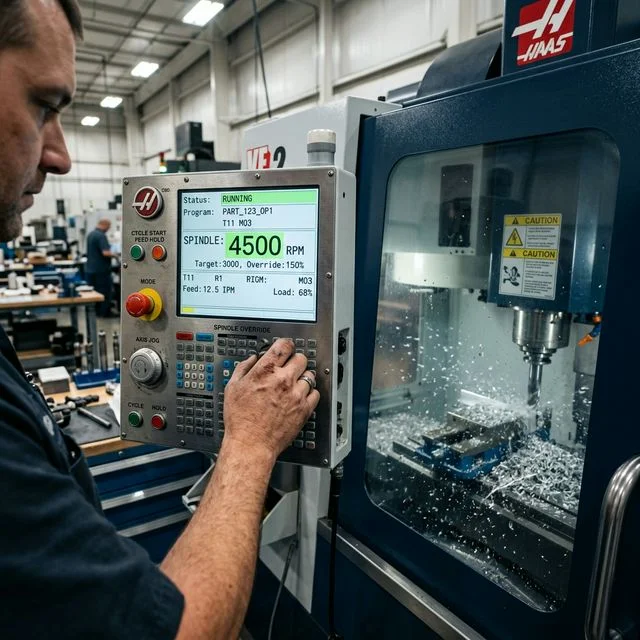
Unit Audit Before Calculator Use
The Imperial Formula (Inches)
RPM = (SFM × 3.82) / Tool Diameter
Where does the 3.82 constant come from?
It's a mathematical shortcut for 12 / π. To find RPM, you are dividing the Surface Speed (Feet) by the Circumference of the tool (Inches). Since you must convert feet to inches, you multiply by 12. Then you divide by Pi (3.14159265...) to account for the tool's circular rotation. 12 ÷ 3.14159 = 3.8197, which the machining world rounds to 3.82.
The Metric Formula (Millimeters)
RPM = (Vc × 318) / Tool Diameter
Where does the 318 constant come from?
The logic is exactly the same, just with Metric units. You define cutting speed (Vc) in Meters per minute, but the tool diameter is in Millimeters. You multiply by 1000 to convert meters to millimeters, then divide by Pi. 1000 ÷ 3.14159 = 318.3, which the industry rounds to 318.
Material-Specific Calculation Examples
Let's apply these formulas to two starkly different materials using the exact same 0.500" (12.7mm) Carbide End Mill. Notice how the material properties dictate massive shifts in the required RPM.
Example 1: 6061 Aluminum
- SFM Recommendation: 800 SFM
- Tool Diameter: 0.500"
- Math: (800 × 3.82) / 0.5
- Result: 3,056 / 0.5
- RPM: 6,112
Example 2: Ti-6Al-4V Titanium
- SFM Recommendation: 150 SFM
- Tool Diameter: 0.500"
- Math: (150 × 3.82) / 0.5
- Result: 573 / 0.5
- RPM: 1,146
If you attempted to cut the Titanium part at the 6,112 RPM generated for Aluminum, the extreme heat generation would instantly melt the carbide cutting edges, ruining the tool in seconds. Conversely, cutting aluminum at 1,146 RPM would result in poor surface finishes and incredibly slow cycle times.
Why Smaller Tools Need More Speed
The formula proves mathematically why micro-machining requires ultra-high-speed spindles. Because the tool diameter is the denominator (the dividing number), as the diameter gets smaller, the resulting RPM grows exponentially to maintain the same surface rubbing speed.
Imagine running a part in mild steel requiring 300 SFM:
- 1.000" Face Mill: 1,146 RPM
- 0.250" End Mill: 4,584 RPM
- 0.050" Micro Mill: 22,920 RPM
- 0.010" Engraving Tool: 114,600 RPM
If you only own a 10,000 RPM spindle, you cannot technically run the 0.050" Micro Mill at its optimal speed of 22,920 RPM. You max out the machine (10k) and must therefore drastically reduce your feed rate to compensate, severely extending your cycle time.
Advanced: Effective Diameter for Ball Mills
The math we've covered assumes you are plunging the tool deep enough that the entire outer diameter is engaged with the metal. But what happens during 3D surfacing with a Ball Nose end mill?
The "Dead Center" Problem
The very tip (center point) of a ball nose end mill has a diameter of exactly 0.000". Because RPM = (SFM × 3.82) / Diameter, if Diameter is 0, the required RPM approaches infinity. The tip of a ball mill essentially has zero surface speed and merely smashes through the material rather than cutting it.
If you take a shallow 0.020" Depth of Cut (DOC) with a 0.500" Ball Mill, the actual width of the tool engaged in the cut is only about 0.196". This is your Effective Diameter (Deff).
Deff = 2 × √[DOC × (ToolDia - DOC)]
You must calculate your required RPM using the Effective Diameter (0.196"), NOT the shank diameter (0.500"). If you used 0.500" to calculate RPM for a shallow 3D surfacing pass, your tool would be spinning far too slowly, essentially dragging the center point and causing rapid tool failure and miserable surface finishes.
The Domino Effect: How RPM Impacts Chip Load
Calculating Spindle Speed (RPM) is only Step 1. The moment you define your RPM, it immediately impacts your machine's Required Feed Rate (IPM) to maintain your target Chip Load (IPT/FPT).
The Feed Rate Formula
Feed Rate (IPM) = RPM × Flutes × Chip Load
If you calculate your RPM incorrectly, your feed rate calculation will also be wrong. If your RPM is too low but you feed at a high IPM, your Chip Load (the thickness of the material removed by each cutting edge) will become massive, instantly breaking the tool.
Conversely, if your RPM is too high and your feed rate is too low, the tool will "rub" rather than cut, generating extreme heat and causing instantaneous tool failure through work hardening or built-up edge (BUE).
Frequently Asked Questions
What is the formula to calculate RPM from SFM?
The Imperial formula to calculate Spindle Speed (RPM) is: RPM = (SFM × 3.82) / Tool Diameter. SFM stands for Surface Feet per Minute, and the diameter is measured in inches.
What is the Metric formula for cutting speed (RPM)?
The Metric formula to calculate Spindle Speed (RPM) is: RPM = (Vc × 318) / Tool Diameter. Vc stands for Cutting Speed in Meters per Minute (m/min), and the diameter is measured in millimeters.
Where does the 3.82 constant come from in the RPM formula?
The constant 3.82 is derived from converting feet to inches and dividing by Pi (π). Specifically, 12 inches per foot divided by 3.14159 equals approximately 3.8197, which is rounded to 3.82 for shop floor calculations.
Why do smaller end mills need higher RPM?
Because surface speed is a measure of how fast the tool's cutting edge travels across the material. A smaller diameter tool has a much smaller circumference. To travel the same distance (surface footage) in one minute as a large tool, the small tool must rotate many more times.
What is Effective Diameter and why does it matter?
Effective Diameter applies specifically to ball nose or bull nose end mills. If you are taking a very shallow depth of cut with a ball mill, the actual diameter of the tool engaged with the material is much smaller than the full shank diameter. You must calculate RPM using this smaller "effective diameter" to achieve the correct surface speed, preventing premature tool wear.